





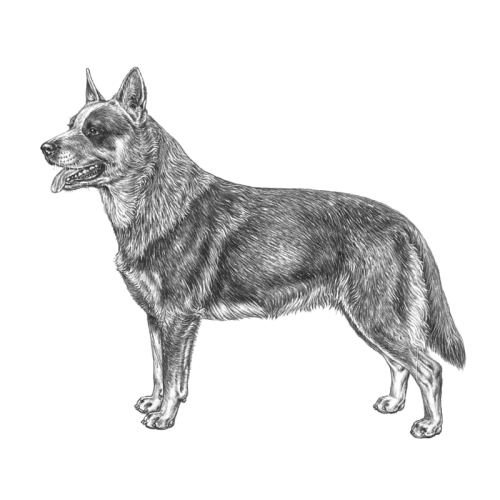

Brief Description
The Australian Cattle Dog is a sturdy, compact, medium-sized herding dog developed in Australia in the 19th century to drive and control cattle over long distances in harsh conditions. Its ancestors include collie-type herding dogs and the dingo. The breed comes in two colours, blue and red speckle. Cattle Dogs are alert, loyal, intelligent and energetic, with a strong guarding instinct – they need plenty of physical and mental work.
Health: Key hereditary health conditions include congenital hereditary sensorineural deafness, progressive retinal atrophy (PRA-prcd), primary lens luxation (PLL), hip and elbow dysplasia, and spondylosis. Neuronal ceroid lipofuscinosis (NCL) has also been described in the breed. Hearing (BAER) testing of puppies and DNA tests for PRA-prcd and PLL are widely recommended.
Breed Standards
The basis of breed/conformation shows is the judging of pedigree dogs against the 'Breed Standard', which is a picture in words that describes the range of features that are deemed appropriate for the breed.
The major international standards are:
Dogs Australia (ANKC), country of origin
FCI (Fédération Cynologique Internationale)
Parent Breed Club
The Australian Cattle Dog Society of NSW
Australian Cattle Dog Club of Victoria
Other Breed Clubs
Finland: Suomen Australiankarjakoirat ry
Sweden: Svenska Australian Cattledog Klubben
Health Strategies
UK: The Royal Kennel Club – breed health information
Finland: Suomen Australiankarjakoirat ry – breeding programme (JTO) and PEVISA and health (in Finnish)
Sweden: Breed-Specific Breeding Strategy (RAS) 2008 (in Swedish) and Svenska Australian Cattledog Klubben – Health (in Swedish)
Research Projects
University of Bern, Institute of Genetics: Focal epilepsy in the Australian Cattle Dog (sample collection)
University of Bern, Institute of Genetics: Maxillary prognathism in Australian Cattle Dogs (sample collection)
Published Research
Seddon et al. 2021: Deafness in Australian Cattle Dogs associated to QTL on chromosome 20 in genome-wide association study analyses
Schmutz et al. 2019: ATP13A2 missense variant in Australian Cattle Dogs with late onset neuronal ceroid lipofuscinosis
Kolicheski et al. 2016: Australian Cattle Dogs with Neuronal Ceroid Lipofuscinosis are Homozygous for a CLN5 Nonsense Mutation Previously Identified in Border Collies
Sommerlad et al. 2014: Consequences of a screening programme on the prevalence of congenital hereditary sensorineural deafness in the Australian Cattle Dog
Sommerlad et al. 2012: Prevalence of congenital hereditary sensorineural deafness in Australian Cattle Dogs and associations with coat characteristics and sex
Other Resources
Finnish Kennel Club Breeding Database – Australian Cattle Dog
Swedish Kennel Club Breeding Data (Avelsdata; in Swedish). Find the breed in the link 'Raser' on left.
Information Lacking?
We are constantly adding and updating the breed information - please contact us if you have updates, links, or other information to add!
 UK
 FI
 SE
- Updated