






Brief Description
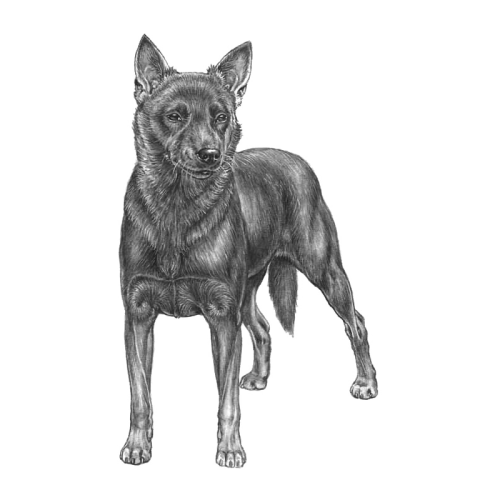
The Australian Kelpie is a medium-sized, lithe and agile herding dog developed in Australia in the late 1800s from Scottish working collies. Kelpies are intelligent, alert and eager, with great stamina and a strong herding instinct – they thrive when given plenty of exercise, mental stimulation and a job to do. Like The American Kennel Club’s website states: ‘He is extremely intelligent, alert, and eager with unlimited energy.’
The Australian Kelpie is bred to the conformation standard and registered by Dogs Australia (ANKC) and FCI member kennel clubs. Dogs selected primarily for working ability are registered separately as the Working Kelpie.
Health: Key hereditary health conditions include cerebellar abiotrophy (CA, an early-onset neurological disease causing ataxia), intestinal lipid malabsorption (ILM), hip dysplasia and epilepsy. Heart disease (mainly mitral valve disease) and cryptorchidism are also reported. DNA tests are available for ILM and for CA risk variants.
Breed Standards
The basis of breed/conformation shows is the judging of pedigree dogs against the 'Breed Standard', which is a picture in words that describes the range of features that are deemed appropriate for the breed.
Three of the major international standards are:
Dogs Australia (ANKC), country of origin
FCI (Fédération Cynologique Internationale)
The American Kennel Club (Foundation Stock Service)
Parent Breed Club
The Australian Kelpie Club of NSW
Other Breed Clubs
Finland: Suomen bordercolliet ja australiankelpiet ry
Sweden: Svenska Kelpieklubben
Health Strategies
Finland: Breed-Specific Breeding Strategy (JTO) 2022–2026 (in Finnish) and English summary of an earlier version (2017)
Sweden: Breed-Specific Breeding Strategy (RAS) 2018–2022 (in Swedish)
Sweden: Svenska Kelpieklubben – Health (in Swedish)
Research Projects
University of Helsinki, Canine Genetics Research Group: Cerebellar ataxia research (incl. Australian Kelpie)
Published Research
Wade et al. 2022: Cerebellar Abiotrophy in Australian Working Kelpies Is Associated with Two Major Risk Loci
O’Brien et al. 2020: A large deletion on CFA28 omitting ACSL5 gene is associated with intestinal lipid malabsorption in the Australian Kelpie dog breed
Chew et al. 2019: Genomic Characterization of External Morphology Traits in Kelpies Does Not Support Common Ancestry with the Australian Dingo
Shearman et al. 2011: Mapping cerebellar abiotrophy in Australian Kelpies
Other Resources
Finnish Kennel Club Breeding Database – Australian Kelpie
Swedish Kennel Club Breeding Data (Avelsdata; in Swedish). Find the breed in the link 'Raser' on left.
Sweden: Svenska Kelpieklubben – Breeding statistics (in Swedish)
Information Lacking?
We are constantly adding and updating the breed information - please contact us if you have updates, links, or other information to add!
 SE
 FI
- Updated