






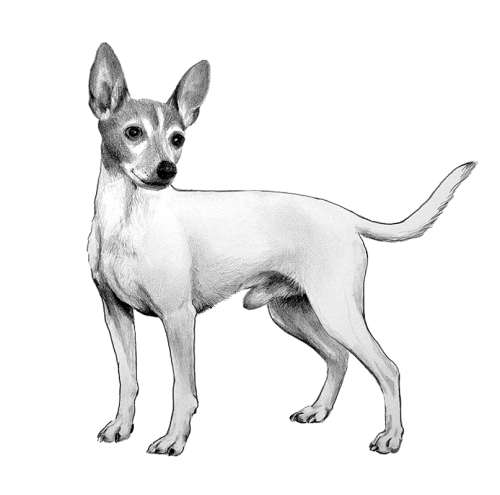
American Toy Fox Terrier
Amerikankääpiökettuterrieri
FCI Group
Not Recognized
AKC Group
Toy
TKC Group
Not Recognized
Country of Origin
US

Health Testing Requirements by Country
Test Relevances
Primary Lens Luxation (PLL)
Moderate Relevance
Canine Cyclic Neutropenia (Grey Collie Syndrome)
Some Relevance
Congenital Hypothyroidism
Some Relevance
Congenital Hypothyroidism
Some Relevance
Primary Lens Luxation (PLL)
Some Relevance
Coat Colour Dilution, dilution, MLPH-related
No Evidence
Degenerative Myelopathy
No Evidence
GM2 Gangliosidosis (Var 0)
No Evidence
Progressive Retinal Atrophy, PRA1
No Evidence
Spongy Degeneration with Cerebella Ataxia Subtype 1, KCNJ10-related
No Evidence
Primary Lens Luxation (PLL)
Moderate Relevance
Canine Cyclic Neutropenia (Grey Collie Syndrome)
Some Relevance
Congenital Hypothyroidism
Some Relevance
Congenital Hypothyroidism
Some Relevance
Primary Lens Luxation (PLL)
Some Relevance
Findings indicate the mutation segregates in a large number of different breeds of dog, many of which are terriers or breeds with terrier co?ancestry, but some of which have more diverse origins. Research indicates that the mutation is present at high frequency within most of the breeds in which it segregates. (Gould et. al, 2011)
Coat Colour Dilution, dilution, MLPH-related
No Evidence
Degenerative Myelopathy
No Evidence
Both clinically rare and of complex inheritance. Test is considered poorly correlated with risk for development of DM, and recommendations are to not use the test for breed-wide breeding strategies. While the SOD 1 variant may be commonly found across many breeds, there are few clinical cases observed and confirmed, and in many cases DM has never been observed in the breeds.
GM2 Gangliosidosis (Var 0)
No Evidence
Progressive Retinal Atrophy, PRA1
No Evidence
Spongy Degeneration with Cerebella Ataxia Subtype 1, KCNJ10-related
No Evidence
- Updated