






American Bulldog
The American Bulldog is a powerful, athletic short-coated dog, strongly muscled, and well boned. The body is just slightly longer than tall. The head is large and broad, with a wide muzzle. Ears are small to medium in size, high set, and may be drop, semi-prick, rose, or cropped. The tail may be docked or natural.The two men who are recognized as the pioneers of bringing the breed back from possible extinction are John D. Johnson and Alan Scott.
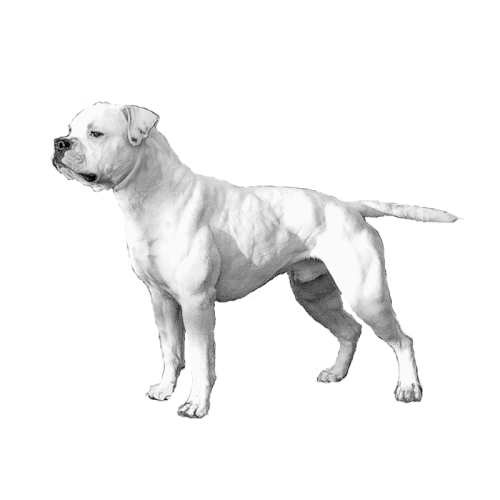
FCI Group
Not Recognized
AKC Group
Foundation Stock Service
TKC Group
Not Recognized
Country of Origin
US

American Bulldog
Health Testing Requirements by Country
Cardiac and Circulatory

Skeletal and Muscular
Endocrine and Pancreas
Eye Conditions and Blindness
Respiratory

Temperament
Autoimmune and Allergies
Skin, Hair, and Nails
Other Breed-Specific Considerations
Other Genetic Testing
Test Relevances
Hyperuricosuria and Hyperuricemia (HUU)
Strong Relevance
Hyperuricosuria and Hyperuricemia (HUU)
Moderate Relevance
Canine Multifocal Retinopathy 1 (cmr1)
Some Relevance
Ichthyosis, NIPAL4-related
Some Relevance
Nemaline Myopathy
Some Relevance
Neuronal Ceroid Lipofuscinosis 10 (NCL10)
Some Relevance
Screw tail
Some Relevance
Canine Multifocal Retinopathy 1 (cmr1)
Some Relevance
Ichthyosis, NIPAL4-related
Some Relevance
Coat Colour Dilution, dilution, MLPH-related
No Evidence
Degenerative Myelopathy
No Evidence
Neuronal Ceroid Lipofuscinosis 5 (NCL5)
No Evidence
Coat Colour Dilution, dilution, MLPH-related
No Evidence
Cystinuria Type I-A
No Evidence
Cystinuria Type II-A
No Evidence
Cystinuria Type II-B
No Evidence
Degenerative Myelopathy
No Evidence
Exercise-Induced Collapse / EIC
No Evidence
Multidrug Resistance 1 (MDR1)
No Evidence
Hyperuricosuria and Hyperuricemia (HUU)
Strong Relevance
Hyperuricosuria and Hyperuricemia (HUU)
Moderate Relevance
Canine Multifocal Retinopathy 1 (cmr1)
Some Relevance
Ichthyosis, NIPAL4-related
Some Relevance
Nemaline Myopathy
Some Relevance
Neuronal Ceroid Lipofuscinosis 10 (NCL10)
Some Relevance
Screw tail
Some Relevance
Research suggests that this variant is associated with many clinical symptoms associated with brachycephalic conformation associated conditions. Variant may be fixed in some breeds.
Canine Multifocal Retinopathy 1 (cmr1)
Some Relevance
Ichthyosis, NIPAL4-related
Some Relevance
Coat Colour Dilution, dilution, MLPH-related
No Evidence
Degenerative Myelopathy
No Evidence
Both clinically rare and of complex inheritance. Test is considered poorly correlated with risk for development of DM, and recommendations are to not use the test for breed-wide breeding strategies. While the SOD 1 variant may be commonly found across many breeds, there are few clinical cases observed and confirmed, and in many cases DM has never been observed in the breeds.
Neuronal Ceroid Lipofuscinosis 5 (NCL5)
No Evidence
Villani et al. (2019) reported the c.619C>T variant to be homozygous in an affected mixed-breed dog of unknown parentage. They also reported a 87kb haplotype including the variant that is shared by this affected dog and the breeds in which this variant has been previously reported. Villani et al. (2019) concluded "that the NCL in all of these dogs stems from the same founding mutation event that may have predated the establishment of the modern dog breeds. If so, the CLN5 nonsence allele is probably segregating in other, as yet unidentified, breeds. Thus, dogs exhibiting similar NCL-like signs should be screened for this CLN5 nonsense allele regardless of breed."
Coat Colour Dilution, dilution, MLPH-related
No Evidence
Cystinuria Type I-A
No Evidence
Possibly incorrect mutation for this breed. See cystinuria type II-A
Cystinuria Type II-A
No Evidence
Cystinuria Type II-B
No Evidence
Degenerative Myelopathy
No Evidence
Both clinically rare and of complex inheritance. Test is considered poorly correlated with risk for development of DM, and recommendations are to not use the test for breed-wide breeding strategies. While the SOD 1 variant may be commonly found across many breeds, there are few clinical cases observed and confirmed, and in many cases DM has never been observed in the breeds.
Exercise-Induced Collapse / EIC
No Evidence
The mutation associated with EIC has been identified in a number of breeds - particularly hunting/working breeds. As the EIC phenotype requires an environmental stimulus in most cases, it should be noted that dogs could be genetically affected for EIC without displaying the condition. It may be valuable to breeders of those breeds where the mutation has been detected to use a genetic test, where breed-specific research is ongoing.
Multidrug Resistance 1 (MDR1)
No Evidence
Connections
- Updated