






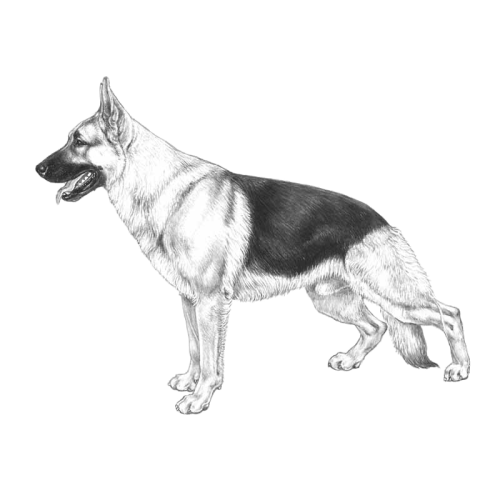

Brief Description
The German Shepherd Dog must be well-balanced (with strong nerves) in terms of character, self-assured, absolutely natural and (except for a stimulated situation) good-natured as well as attentive and willing to please. He must possess instinctive behavior, resilience and self-assurance in order to be suitable as a companion, guard, protection, service and herding dog. (source: FCI breed standard)
German Shepherds are widely used in police, military, and search and rescue work. They are also kept as family pets and used in competitive protection and other hobbies.
The breed is divided into two genetically different lines: a working line focusing on competition and working dogs, and a show line focusing on appearance and dog shows.
The breed comes with two coat variants: the short-haired and the long-haired.
Health: The major hereditary problems in the German Shepherd are immunological diseases and various skeletal diseases.
Breed Standards
The basis of breed/conformation shows is the judging of pedigree dogs against the 'Breed Standard', which is a picture in words that describes the range of features that are deemed appropriate for the breed.
Three of the major international standards are:
Health Strategies
Research Projects
Parent Breed Club
German Kennel Club (VDH)
The VDH is the umbrella organisation for more than 168 membership organisations in the whole of Germany. Here you can find the contact details for all VDH organizations.
Other Resources
Finnish Kennel Club Breeding Database - German Shepherd
Swedish Kennel Club Breeding Data (Avelsdata; in Swedish). Find the breed in the link 'Raser' on left.
Information Lacking?
We are constantly adding and updating the breed information - please contact us if you have updates, links, or other information to add!
 UK
UK
 SE
SE
 FI
FI
- Updated