






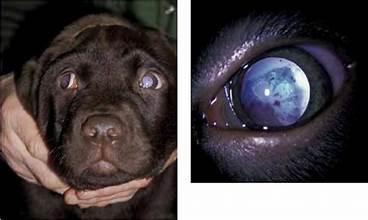
Key Comment: Multiple research sources indicate that this form of PRA-prcd could be present in many breeds, and testing could be relevant widely across a large number of different breeds of dog, many of which are terriers or breeds with terrier co-ancestry, but some of which have more diverse origins. Research indicates that the mutation is present at varying breed-specific frequency, but that testing and applying the test results can lead to signifigant reduction in the disease.
PRA-prcd is progressive, and late-onset, where retina cells are lost slowly. This initially causes problems seeing in dim light, usually around ages 3-5, though diagnosis by an ophthalmologist can be earlier, around 1-2 years. It can progress to complete blindness is some dogs, but not all cases. This disease is seen in many breeds and crosses.
Canine progressive rod-cone degeneration (prcd) is a retinal disease previously mapped to a broad, gene-rich centromeric region of canine chromosome 9. An allelic disorders present in multiple breeds, and crosses of those breeds. Research strongly suggests that a common ancestor transmitted the prcd disease allele to many of the modern dog breeds. Diagnosis of prcd is based on a combination of clinical examination, including indirect ophthalmoscopy and electroretinography, and retinal morphology. Retinal photoreceptor abnormalities are visible in animals 14 weeks of age and older using high-resolution optical microscopy.
- Updated
- Add Condition