








This is a 'living document' - so if anyone has more material to share or point us to - please let us know!
Havanese at a Glance
Bichon Havanais, The Havanese, is a small bichon-type toy dog and a national dog of Cuba. The Havanese are exceptionally bright, so they are easy to train as alarm dogs. The breed is affectionate, of a happy nature, amiable, a charmer, playful, and even a bit of a clown. Havanese love children and play endlessly with them (FCI breed standard).
What Do Caretakers Need to Know?
As a small, alarming dog, Havanese are prone to use their voice.
The silky textured coat needs frequent maintenance.
Key Hereditary Health Conditions
The most important hereditary problems in the Havanese are luxating patella, cranial cruciate ligament ruptures, heart disease, eye disease (cataracts, cherry eye, distichiasis), and liver disease (portosystemic shunt).
In Swedish insurance data, Havanese are healthier than average. The most common reasons for veterinary visits are stomach and intestinal symptoms, symptoms from the musculoskeletal system, and skin problems. Skin problems can for example be about inflammation of the skin, bacterial infection, and hair follicle inflammation. Source: Agria
The Havanese is a short-legged breed. Short legs are the result of chondrodysplasia (CDPA), where the growth plates of the long bones close prematurely. This can cause varying degrees of curvature in the front legs and painful changes in the wrist and joints, such as incongruency and resulting arthrosis of the elbow joint. To minimize problems, breeding dogs should have straight legs, and the shortness of the legs should not be exaggerated. CDPA can be tested. The dogs with two copies have shorter legs than those having only one copy.
Some Havanese are chondrodystrophic, having a CDDY retrogene in their chromosome 12. This retrogene shortens the legs a bit further and causes also premature degeneration of intervertebral discs. Thus, it predisposes dogs to disc herniation, a painful condition with a high mortality rate. CDDY is a dominant (or additive) gene that can also be tested.
Statistics (Morbidity and Mortality)
Agria - Swedish Breed Profiles 
We recommend that you download the Agria Breed Profiles for the breed from the Breed page (Access is free, but sign-in to DogWellNet is required), and study them for full available information. Some excerpts are shown below.
The great benefits of the Swedish Insurance Data are that they include almost 40% of the national population of dogs and so are very representative. Note that animals at very old ages are likely under-represented. Most importantly, information is available on all insured dogs, not simply those who get sick or die.
Extracts from Veterinary Care Events – MORBIDITY
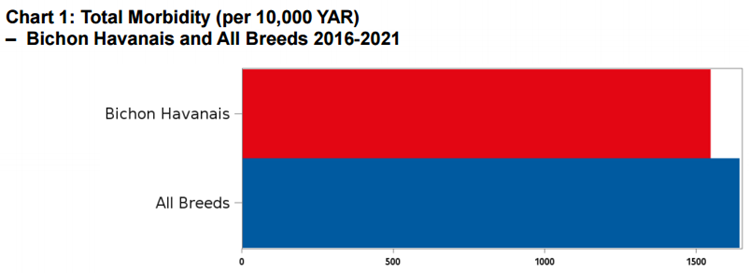
Relative morbidity risk in Havanese compared to all breeds (Chart 1 below): 0.95 (The risk in the breed is somewhat smaller than for All Breeds). This means that Havanese visit the vet less often than the comparison group All Breeds.
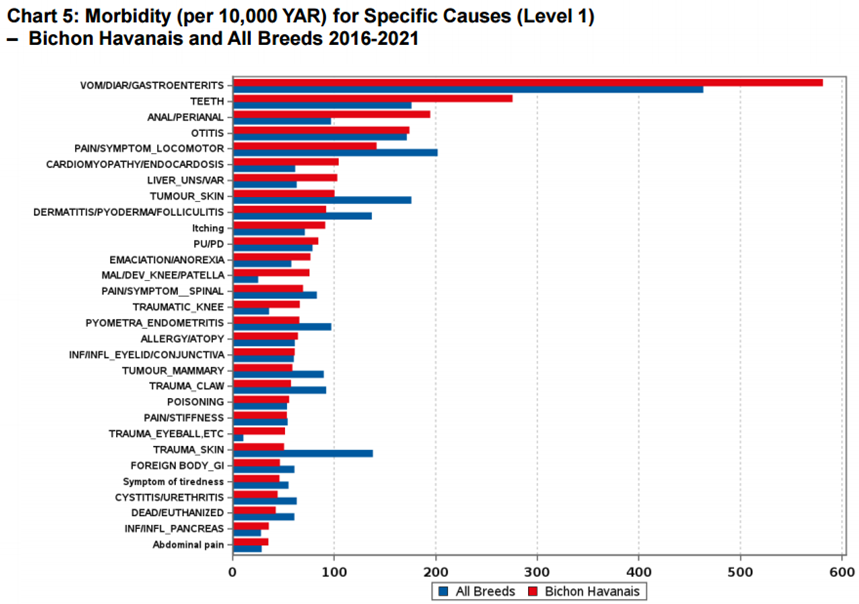
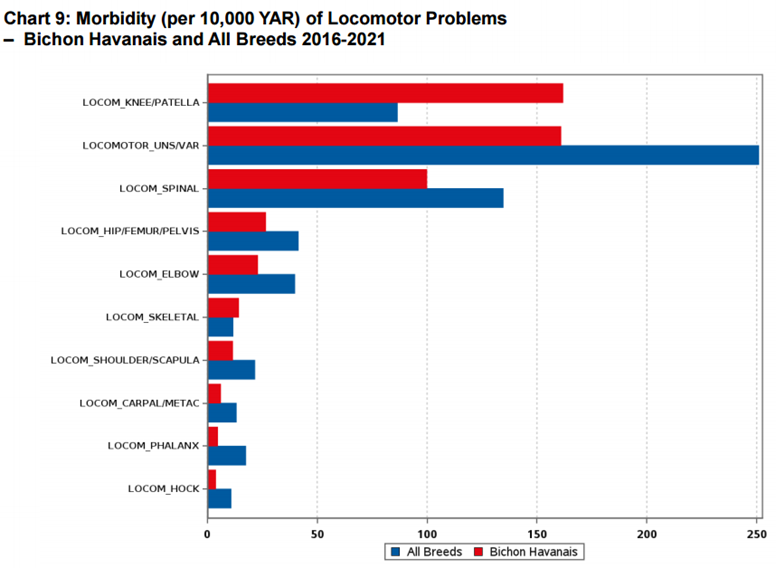
Compared to the All Breeds group, Havanese have more veterinary visits for gastrointestinal symptoms, dental disease and symptoms from the anal area (Chart 5). Also skin problems (otitis and itching - the breed is predisposed to sebaceous adenitis), heart disease, and liver problems (shunt) are more common in the breed than in the All Breeds group. Patella problems appear almost twice as often compared to All Breeds (Chart 9).
Agria charts - Morbidity
Extracts from Agria Breed Profile (Life) – MORTALITY
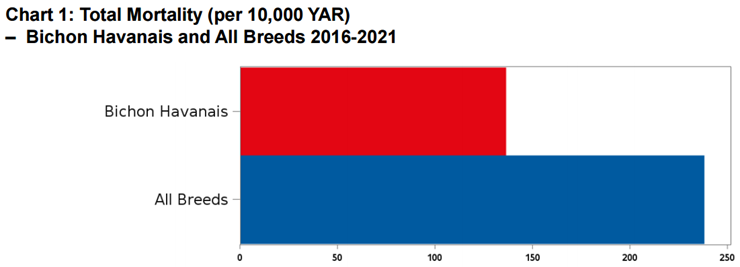
Median Age (years) at death: 8.2, which is clearly higher than in All Breeds (6.9). That is why the Relative Risk Mortality compared to All Breeds is almost half smaller (0.57; Chart 1 below).
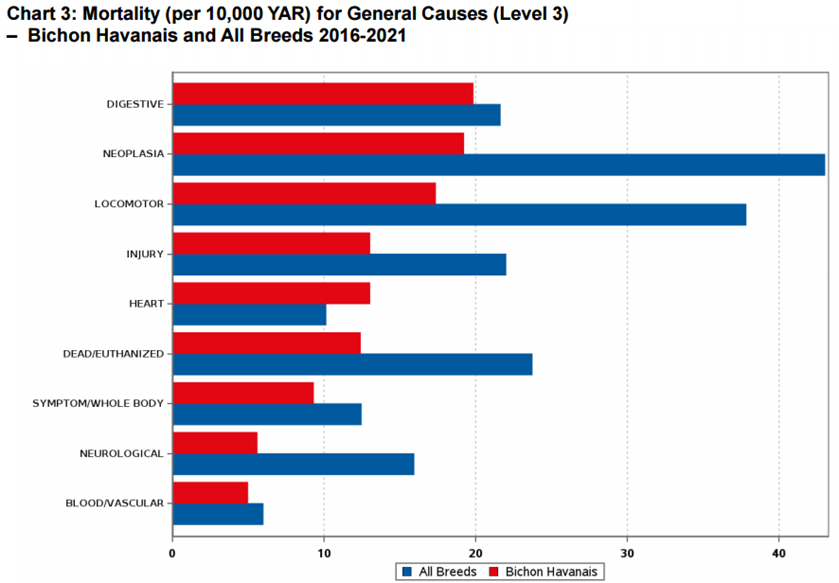
Most frequent general causes of death (Chart 3, and Chart 6, which is not shown here): digestive, neoplasia, locomotor, injury, and heart. Of these, only heart is more common than in All Breeds.
Agria charts - Mortality
Finland – Finnish Kennel Club Mortality Data
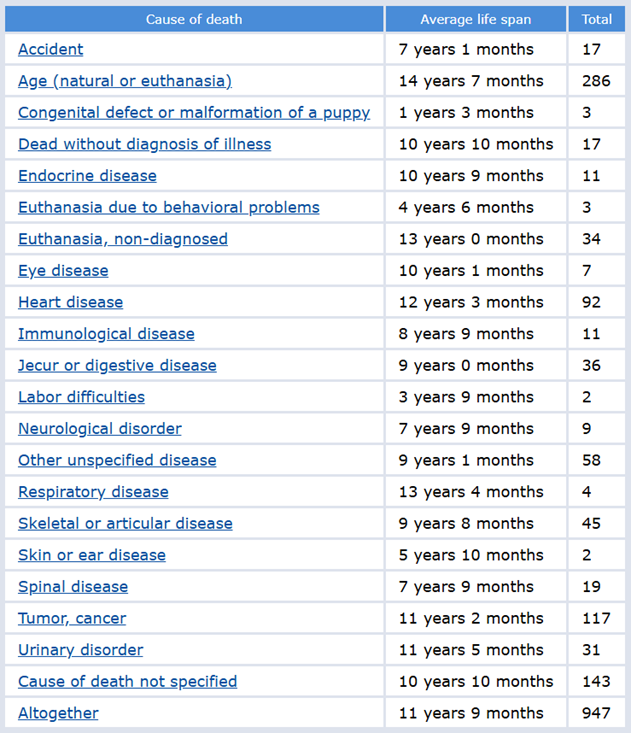
The average life expectancy according to the Finnish statistics is 11 years 9 months.
The most common specified causes of death are old age (at 14 years 7 months), tumor/cancer (11 y 2 mo) , heart disease (12 y 3 mo), and skeletal or articular disease (11 y 8 mo).
Finnish Kennel Club Mortality Statistics 2015->
Source: Finnish Kennel Club breeding database
Life Expectancy
US: 14-16 years (American Kennel Club)
The Netherlands: over 12 years (Raad van Beheer)
UK: over 12 years (Royal Kennel Club)
Health Screening
DNA Tests – Harmonization of Genetic Testing for Dogs
The Harmonization of Genetic Testing for Dogs (HGTD) is a large collaborative project run by the IPFDogs.
The HGTD includes 82 academic and commercial genetic test providers (GTPs) in 26 countries.
See the HGTD – DNA tests for the Havanese on the breed's page (section: Connections). The colours of the tests mark for Breed Relevance Ratings (BRR). BRR indicates the level of available evidence supporting the application of a specific genetic test for a specific breed/type:
 Some, moderate or strong evidence from available research. The test may be meaningful or recommended for this breed.
 Currently no evidence of relevance for the use of this test in this breed, or the test is not known in this breed. This rating should be expected to change as evidence becomes available.
 All current available evidence has been reviewed, but relevance is inconclusive, and/or the clinical form of the disease has never been seen in this breed.
 All current evidence indicates that the test is not meaningful or recommended in this breed.
Click here for more information on the HGTD project
Summary: Most relevant DNA tests for the breed are chondrodysplasia (CDPA, short legs), chondrodystrophy (CDDY and intervertebral disc disease), and factor VIII deficiency (a bleeding disorder).
Health Screening Summary - By Country
(Source: Breeding Strategies, see below)
R1-Mandatory screening for litter registration
R2-Recommended to screen (if there’s a test) or take into consideration in other way
R3-Recognized
Note: Please let us know if there have been changes to the health screening requirements in your country, so we can update our data.
Condition/ Trait | US | FI | FR | GE | IT | NL | NO | SWE | UK |
Patella luxation | R2 | R1 | R1 | R2 | R2 | R2 | R1 | R2 | R2 |
Hip dysplasia | R2 | R2 |
|
|
| R3 |
|
| R3 |
Elbow dysplasia/incongruency
|
|
|
|
|
| R3 |
|
| R3 |
CDPA/CDDY* | R3 | R2 |
|
|
|
| R2 | R3 | R3 |
Spine issues |
|
|
|
|
|
|
| R2 |
|
Eye disease | R2 | R1 | R2 | R1 | R2 | R2 | R1 | R2 | R2 |
Legg-Calve-Perthes | R3 | R2 |
|
|
|
|
|
|
|
Deafness | R3 |
|
|
|
| R2 |
|
|
|
Allergy, atopy |
| R2 |
|
|
|
|
| R2 |
|
Sebaceous Adenitis (SA) | R3 | R2 |
|
|
|
|
| R2 |
|
Thyroid | R3 |
|
|
|
|
|
|
|
|
Cardiac disease | R3 | R2 |
|
|
|
|
| R2 | R3 |
Epilepsy |
|
|
|
|
| R3 |
| R2 |
|
Max N of offspring |
| R1 |
|
|
|
|
|
|
|
*CDPA = chondrodysplasia, CDDY = chondrodystrophy and intervertebral disc disease
Note: The table above provides some of the most common health screening information from clubs in the countries listed. See the individual club websites for the most recent and accurate information on health management in the breed.
Breeding Strategies and Health Info
US (Breed Club and OFA)
Havanese Club of America, health
OFA - Recommended health screening tests for the breed (CHIC)
OFA Statistics - % healthy of the examined dogs since 2006:
Hip dysplasia: 89,5 %
Elbow dysplasia: 91,8 %
Eye diseases: 96,8 %
Cardiac (Advanced): 92 %
Thyroid: 84,7 %
Chondrodysplasia (CDPA): 11,8 %
Scandinavian Countries
Finland: Jalostuksen tavoiteohjelma (JTO) in Finnish
Sweden: Rasspecifik avelsstrategi (RAS) in Swedish
Percent healthy of the examined dogs (2015-2024):
Patella luxation: Finland 85 %, Norway (2023-2024) 62 %, Sweden 92 %
Eye diseases: Finland 82 %, Norway 75 %, Sweden 95 %.
Hip dysplasia: Finland 43 %, Norway 35 %, Sweden 40 %
CDDY/CDPA genetic testing results of Finnish dogs >>. 218 dogs have been tested by the end of November, of which
CDDY/CDDY 4 dogs,
N/CDDY 46 dogs,
N/N (no CDDY) 168 dogs,
CDPA/CDPA 209 dogs, and
N/CDPA 10 dogs.
The Finnish breed club is using gonioscopy to examine dogs’ leg curvature. Gonioscopy is completely safe for dogs and does not require sedation. More information and measurement results of Finnish dogs can be found in this link >>.
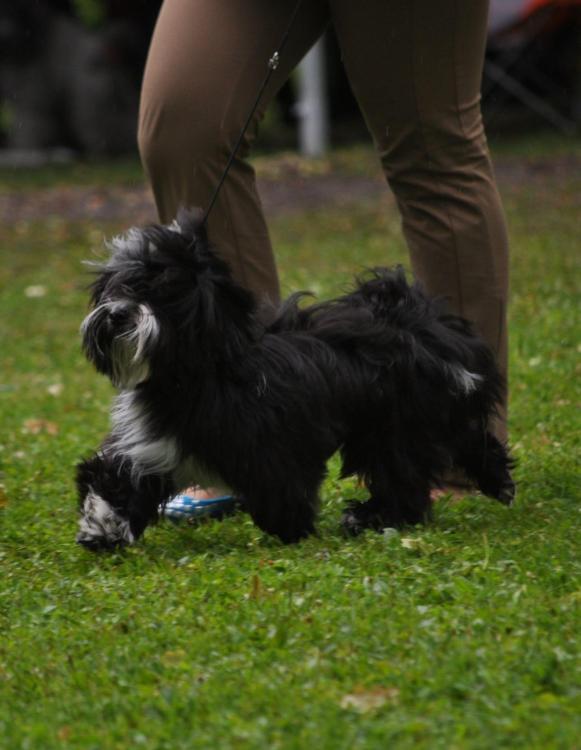
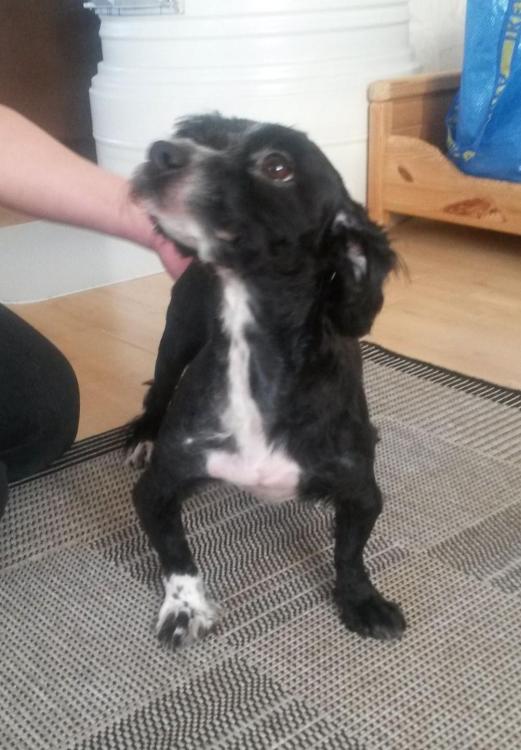
Below you can see photos of two dogs from Finland. One with straight legs and another with extreme leg curvature and elbow incongruency.
Example of the leg curvature
The dog on the center and on the right is the same individual:

France
GRILLE DE SELECTION / La Centrale Canine (French Kennel Club, SCC):
Havanese breeding dogs must have an official ECVO eye disease screening. Only dogs free from eye defects will be eligible for a rating.
Results in the SCC database: 132 dogs examined, 119 healthy (Aug 2025).
Germany
Breeding requirements (Verband Deutscher Kleinhundezüchter e.V.)
Requirements for breeding: DNA profile and eye examination, free of cataract. See Zuchtzulassungsordnung
Italy
Statistics and health requirements by Ente Nazionale della Cinofilia Italiana (Italian Kennel Club, ENCI)
The Netherlands
Breeding rules of the breed clubs (2):
UK
The Royal Kennel Club (RKC) health testing standard
Good practice: eye examination. Best practice: eye examination and elbow dysplasia screening
Research
Bellamy 2023. Genetic studies of health challenges and behaviour in the Havanese dog breed. Doctoral Thesis. Norwegian University of Life Sciences, Ås.
“Havanese is the most registered companion dog breed in Norway, and is generally a healthy and long-lived breed. However, published studies, as well as health surveys conducted by the breed club, indicate a predisposition to some issues, including cataracts, foreleg abnormalities, social fear and distichiasis. This thesis addresses these challenges and provides new information that will be useful in planning an overall breeding strategy.”
Bellamy and Lingaas 2020. Short and sweet: foreleg abnormalities in Havanese and the role of the FGF4 retrogene. Canine Medicine and Genetics 7:19.
McMillan, Bielby, Williams, Upjohn, Casey and Christley 2024. Longevity of companion dog breeds: those at risk from early death. Scientific Reports. 14 (1). Springer Science and Business Media LLC. doi:10.1038/s41598-023-50458-w
“The Havanese are predisposed to portosystemic shunt: 4.35% of Havanese had the condition compared to 0.35% for mixed-breed dogs.”
References and Resources
Breed Clubs
USA - Havanese Club of America
Finland - Havannankoirat ry
Germany - Verband Deutscher Kleinhundezüchter e.V.
Italy - Club Cani Compagnia
Norway - Norsk Bichon Havanais Klubb
Sweden - Bichon Bolognese & Havanais Club
The Netherlands - Eerste Gezelschapshonden Club Nederland
The Netherlands - Havanezer Club Nederland
UK - Havanese Club of GB
Information Lacking?
We are constantly adding and updating the breed information - please contact us if you have updates, links, or other information to add!
- Updated