






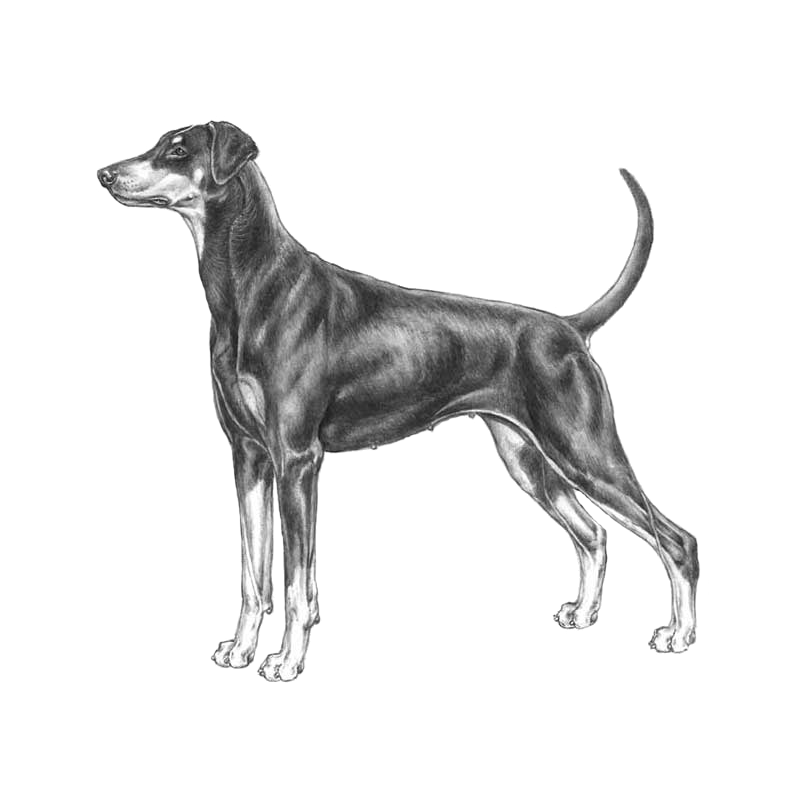

- Brief Description
The Dobermann is the only German breed which bears the name of its original breeder, Friedrich Louis Dobermann (02.01.1834 – 09.06.1894). He was believed to be a tax collector, offal abbatoir manager (knacker) and a part time dog catcher, legally able to catch all stray dogs. He bred with animals from this reservoir that were particularly sharp. The so called “butcher’s dogs” which were already considered a relatively pure breed at that time, played a most important role in the origination of the Dobermann breed.
Source: FCI
- Links to Breed Descriptions
See: The German Kennel Club (VDH) for information and video (if available).
(Hint: your browser should be able to Translate to English, at least for text (e.g., right click in Google Chrome or Internet Explorer).)This and other breed videos are available in full length here
View more videos on AKC's YouTube Channel
View more videos on SCC's YouTube Channel
Doberman Pinscher Club of America: Illustrated Standard
Sweden: Dobermann Raskompendium - SBK ́s domarkonferens
18-20 oktober 2019
Svenska Dobermannklubbe - Other Names for Breed
- Doberman Pinscher
- Country of Origin and Parent Breed Club
Country of origin: Germany
- Health and Well-Being
Some sources of health information include:
- National kennel clubs and breed clubs (see, e.g. Breeding/Health Strategy Documents, below)
- Population-level statistics (see, e.g., Swedish Insurance Data, below)
- Research articles
- Breed club surveys
- Breed-Specific Articles
 See our article, Get a GRIHP! on the Dobermann for important information on the Dobermann.
Be aware: Dogs with dilated cardiomyopathy in the symptomatic stage often experience coughing, poor performance, high respiratory rate, or shortness of breath. In some cases, there are also fainting spells. Sudden deaths due to cardiac arrhythmias also occur. The disease can occur at any age, mostly animals between one and a half and seven years are affected. Indicative symptoms of heart disease are:
- Cough
- Significantly decreasing joy of playing and resilience
- accelerated breathing to the point of shortness of breath
- Cyanosis (blue skin, lips, nail bed)
- Syncope (fainting spells)
- ascites (fluid build-up)
- accelerated heart rate
- cardiac arrhythmias
- Breed Standards
There are numerous breed standards.
The basis of breed/conformation shows is the judging of pedigree dogs against the 'Breed Standard', which is a picture in words that describes the range of features that are deemed appropriate for the breed.
Three of the major international standards are:
- Breed-Specific Statistics
1. Swedish Insurance Data
- Breed-specific information on rates of disease and death from Agria Pet Insurance (Agria Djurförsäkring) is available for many breeds.
This breed has information on Veterinary Care and Life Insurance.2. Finnish Kennel Club Database - Dobermann: https://jalostus.kennelliitto.fi/frmEtusivu.aspx?R=143
- Breeding/Health Strategy Documents
Health/Breeding Strategy Documents and Links:
- The Kennel Club, UK: Breed Watch (Category 1)
- Sweden: Breed-specific Breeding Strategies: (in Swedish) and/ or English summary
- Finland: Jalostuksen tavoiteohjelma 2020-2024 - DOBERMANN
- Breed-Specific DNA Tests
- Other Breed-Specific Webpages
- Breed-Specific Research
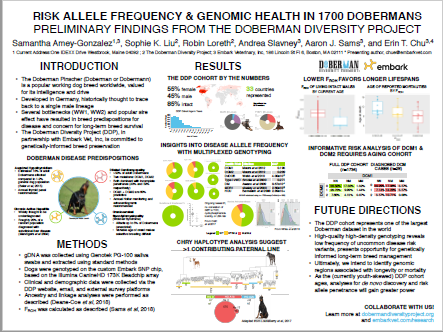
See the POSTER
This poster was displayed at the 4th International Dog Health Workshop.
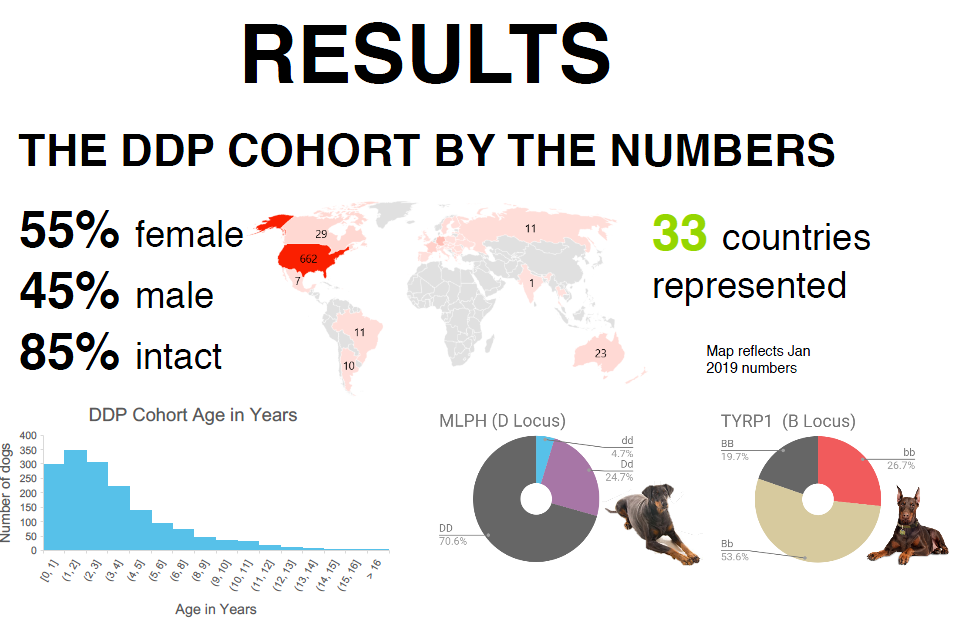
The poster provides an overview of results of genetic testing done by Embark through its Doberman Diversity Project panel test.
Genetic disease predisposition and diversity information is available.
Current participants / cohort data...
...primarily young dogs from the US
...
2023 Research
Wade, C.M., Nuttall, R. & Liu, S. Comprehensive analysis of geographic and breed-purpose influences on genetic diversity and inherited disease risk in the Doberman dog breed. Canine Med Genet 10, 7 (2023). https://doi.org/10.1186/s40575-023-00130-3
Excerpt... a global perspective
"Abstract
BackgroundPublicly available phenotype data and genotyping array data from two citizen science projects: “Doberman Health Surveys” and “The Doberman Diversity Project” were analyzed to explore relative homozygosity, diversity, and disorder risk according to geographical locale and breeding purpose in the Doberman."
- Breed Clubs
We are listing sites for breed clubs with health or other information that might be helpful. Follow links below.
Canada: Doberman Pinscher Club of Canada
Germany: Dobermann Verein e.V.
UK: The Dobermann Club
USA: Doberman Pinscher Club of America
Finland: Suomen Dobermann Yhdistys Ry
 ...
...
The Dobermann breed requires a medium sized, powerful, muscular dog. Despite his substance he shall be elegant and noble, which will be evident in his body line. He must be exceptionally suitable as a companion, protection and working dog and also as a family dog.
Recommended Comments
Join the conversation
You can post now and register later. If you have an account, sign in now to post with your account.
Note: Your post will require moderator approval before it will be visible.