





6th IDHW Reflections...continued

By Marc Ralsky in General
· Viewed: 1,657 times
Continued from my previous entry: All Roads Lead to Dog Health...and They've Converged in Bologna
Better Breeding for Health Means Measuring What Matters
One of the most valuable things about the International Dog Health Workshop is that I’ve seen now that we do not always leave with neat, easy answers.
Sometimes we leave with better questions.
That may not sound like progress, but it is. Because if we are asking the right questions, together, across countries, organizations and disciplines, we are much more likely to find practical ways forward for dogs.
 At the sixth International Dog Health Workshop in Bologna, one of the most robust conversations focused on breeding for health and well-being.
It is easy to say that we want ‘healthier’ dogs. Nobody in the room would disagree with that. But the real work begins when we ask what ‘healthy’ means, how we measure it, and whether the programs we create are making a meaningful difference.
For many years, breeders, kennel clubs, veterinarians, researchers, and breed organizations have invested enormous time, money, and effort in health programs. Screening programs. DNA tests. Breed health strategies. Recommendations. Requirements. Education.
But one of the questions raised in Bologna was both simple and important: Are we evaluating whether these programs are working?
Breeding is not a quick process. It takes time to see change. But that does not mean we should simply create a program, ask breeders to participate, and assume it has achieved its purpose.
We need to ask some fundamental questions: Is a program is accessible? Can people realistically take part? Is the testing available where they live? Is it affordable? Is it practical? Are breeders able to understand the results and use them effectively?
And perhaps most importantly…is it helping us breed dogs that live healthier lives?
There was significant discussion about longevity and health during a dog’s lifespan. Not simply how long a dog lives, but how long a dog lives well.
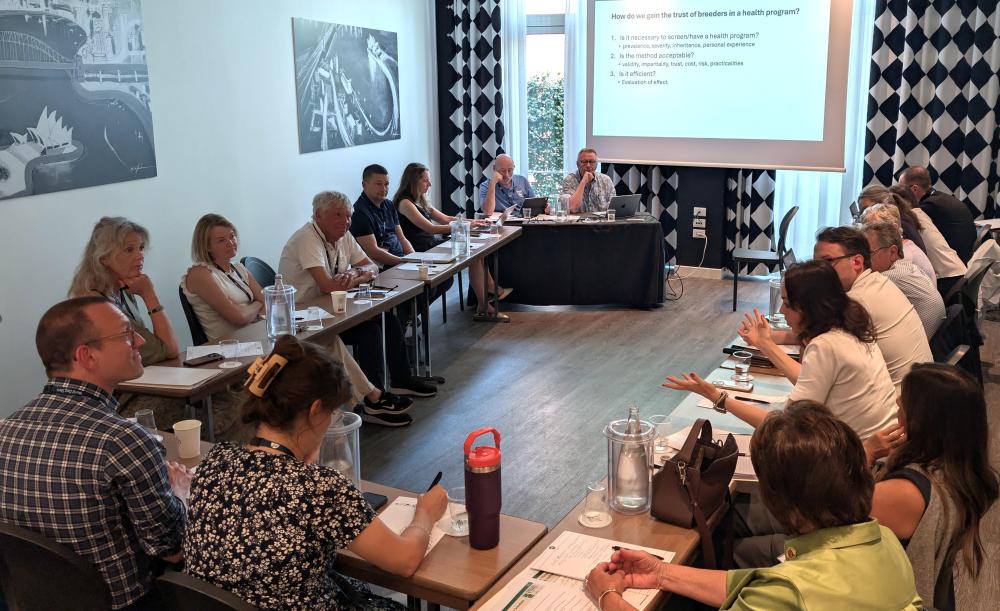 That is a much more meaningful conversation – and that is what sets an IPFDogs workshop apart from a conference.
A long life is not always a healthy life. A dog may live many years while enduring pain, chronic disease, or reduced quality of life. So perhaps the question is not only, “How old are our dogs when they die?”, but also, “How many of those years are they healthy, active, and able to enjoy life as dogs should?”.
This is not a simple measure. It must be considered within breeds, populations, and individual circumstances. But it’s a conversation worth having.
Another recurring theme in our discussions was the need to share good examples.
Too often, dog health conversations focus only on what has gone wrong. We all know there are serious challenges in some breeds and populations. We cannot ignore them. But if we only tell stories of failure, we may overlook the breeders, clubs, and organizations whose thoughtful, patient, and responsible work has brought about positive change. I think there are more of these stories than the former – they just aren’t broadcasting what they’re doing. How do we reach them? What do we say to them? How do we learn from them?
People need to see what success looks like.
They need practical examples of breed health programs that have made a difference. They need to see what collaboration between breeders, veterinarians, and researchers can achieve. They need tools that are understandable, useful, and relevant to the decisions being made in real kennels and real homes.
That is one of the reasons IPFDogs exists.
We are not here to tell every country, breed club, or breeder exactly what to do. We are here to bring people together, help share knowledge, and make it easier to learn from the excellent work already happening around the world.
 The new IPFDogs website – The Dog Wellness Network – is part of that commitment. It has tremendous potential to become the dog world’s central hub for breed-specific information, health recommendations, practical resources, and documented examples of progress. But it can only be as strong as the community that contributes to it.
IPFDogs is not just a small team sitting behind a website or organizing a workshop every two years.
IPFDogs is all of us.
I PFDogs is the people who gather the information. The people who share it. The breeders who use it. The researchers who ask better questions. The veterinarians who help translate science into practical decisions. The kennel clubs and welfare organizations that create the conditions for change.
Bologna reminded us that healthier dogs will not come from one regulation, one test, or one organization.
They will come from better questions, better information, honest evaluation, and a shared willingness to keep learning.
That is work worth doing.
Thank you again to Agria, Royal Canin, and ENCI for helping us make these important conversations possible.
More to come...
Recommended Comments