







Skip to content
View in the app

A better way to browse. Learn more.

DogWellNet

A full-screen app on your home screen with push notifications, badges and more.

To install this app on iOS and iPadOS
  1. Tap the Share icon in Safari
  2. Scroll the menu and tap Add to Home Screen.
  3. Tap Add in the top-right corner.
To install this app on Android
  1. Tap the 3-dot menu (⋮) in the top-right corner of the browser.
  2. Tap Add to Home screen or Install app.
  3. Confirm by tapping Install.

Genetic mapping of principal components of canine pelvic morphology

By DWN Staff
Published

cgelogov2.pngFealey et al. Canine Genetics and Epidemiology

(2017) 4:4

DOI 10.1186/s40575-017-0043-7


Plain English Summary


"Concentrated breeding effort to produce various body structures and behaviors to suit human demand has inadvertently produced unwanted traits and diseases that accompany the external appearance and behavior of dogs. Purebred dogs, which are predisposed, or not, to HD share common features of their shape and size, respectively.


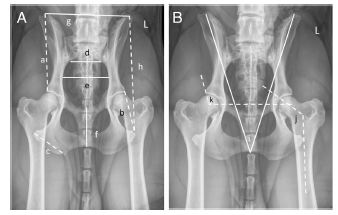
Thirteen unique anatomical features of the pelvis were measured on radiographs of 392 dogs of 51 breeds and 95 mixed breed dogs. Combinations of these measurements together described the shape and size of the pelvis. Male dogs had significantly larger pelves than female dogs. Genetic markers pointed to insulin-like growth factor-1 as a major driver of pelvic size. A second genetic marker was associated with ilial length and ischial width on canine chromosome 16.


Conclusion: Based on the current study, pelvic shape alone was not strongly associated with canine hip dysplasia."


Edited by Ann Milligan

User Feedback

Recommended Comments

There are no comments to display.

Join the conversation

You can post now and register later. If you have an account, sign in now to post with your account.
Note: Your post will require moderator approval before it will be visible.

Guest
Add a comment...
Disclaimer
All materials on this site are the property of their respective authors and may not be reprinted without the author's written permission, unless otherwise indicated. The views and opinions expressed by the authors and those providing information or comments on this website are theirs alone, and do not necessarily reflect the views, opinions or positions of the International Partnership for Dogs (IPFDogs) or DogWellNet.com. We make no representations as to accuracy, completeness, timeliness, suitability or validity of any information and will not be liable for any errors, omissions, or delays in this information or any losses, injuries or damages arising from its display or use. All rights reserved. DogWellNet © 2014 - 2026
Find Us On
Contact Us
Questions? Comments? Looking to get involved in our work? We’d like to hear from you!
or if you prefer feel free to reach out to us on social media.

Powered by Invision Community

Important Information

By using this site, you agree to our Terms of Use.

Account

Navigation

Search

Search

Configure browser push notifications

Chrome (Android)
  1. Tap the lock icon next to the address bar.
  2. Tap Permissions → Notifications.
  3. Adjust your preference.
Chrome (Desktop)
  1. Click the padlock icon in the address bar.
  2. Select Site settings.
  3. Find Notifications and adjust your preference.