






Finnish Investigation: Improving the implementation of animal welfare legislation in animal breeding
Part II: Preliminary analysis of problems and means of intervention in the breeding of dogs
Table of Contents
Background
 The Finnish Food Authority commissioned a study with the aim to create conditions for alleviating welfare problems due to harmful breeding in fur animals, dogs and cats. Under the Animal Welfare and Identification Unit, the approver was: Sari Salminen, Senior Inspector; the authors were Riitta Kempe, PhD (animal breeding), researcher; and Katariina Mäki, PhD (animal breeding), breeding expert, researcher, Natural Resources Institute, Animal Genetics. In addition, expert specialists DVM, PhD Merja Dahlbom; DVM Anna-Mariam Kiviranta; DVM, PhD Anu Lappalainen; DVM, PhD Liisa Lilja-Maula; DVM Lena Lindh; DVM Kirsti Schildt; DVM Tuire Tamminen; Senior Specialist at the Ministry of Agriculture and Forestry Tiina Pullola; Senior Inspector of the Finnish Food Authority Taina Mikkonen contributed to the Report.
The outcome is a comprehensive and insightful 89 page compendium including:
- general guidelines for breeding dogs
- current challenges in dog populations and welfare management
- actions taken by kennel and breed clubs to identify and evaluate health conditions
- references to existing animal welfare legislation in Finland and several other EU countries
- research into studied health issues in breeds, particularly those conditions that impact brachycephalic dogs
- proposed monitoring and control criteria that apply to pedigree and mixed breed dogs
Who is this information for?
This report is an in depth, evidence-based reference for anyone working in the area of health and breeding for pedigree dogs, including .kennel and breed clubs that are defining actions relative to brachycephalic breeds, breed health councils, legislators/policy-makers, veterinary organizations, and welfare groups.
Portions of this report may be informative for breeders, particularly as concerns specifics of investigated health issues.
The average dog owner will not likely be focused on the specifics of research cited in parts of the report. Although primarily focused on brachycephalic dog breed health and welfare issues... much relates to pedigree dogs and their breeding in general. In the future the contents of this report may contribute to the construct of legislation pertaining to management of dogs which impacts society at large.
 Finnish Report
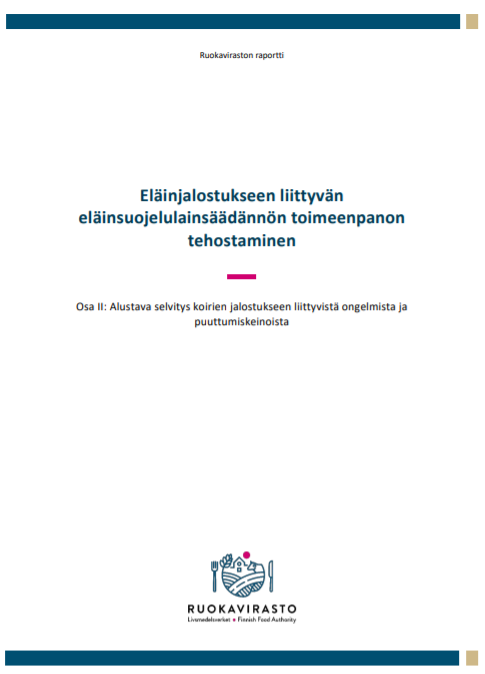
- Link to the Original Report (in Finnish): Eläinjalostukseen liittyvän eläinsuojelulainsäädännön toimeenpanon tehostaminen Osa II: Alustava selvitys koirien jalostukseen liittyvistä ongelmista ja puuttumiskeinoista
- (Internal link) jalostuksen-valvontakriteerit_koira_2020-luke-dwnld.pdf
English - Translation
This translation has been facilitated by the International Partnership for Dogs. We extend our thanks to Katariina Mäki for her assistance with the translation. Disclaimer: The IPFD and Ms. Mäki take no responsibility for the accuracy of the translation and readers are directed to the Finnish version as the true source.
- MSWord Version
Also relevant
Challenges for Pedigree Dogs: Regulatory Enforcement of Brachycephalic Dogs in the Netherlands; which includes links to responses from various other stakeholders and kennel clubs as well as upcoming articles in:
Think Globally, Act Locally
A category for discussions on promoting collective and collaborative actions for dog health and welfare and human-dog interactions.
Our IPFD partner, the Finnish Kennel Club is a progressive and proactive national kennel club, taking leadership on breed-specific programs for dog health. See, e.g.:
Note: IF anyone is using this resource or reads the whole... you are welcome to come back with queries or comments...
Recommended Comments
Join the conversation
You can post now and register later. If you have an account, sign in now to post with your account.
Note: Your post will require moderator approval before it will be visible.