





Brachycephalics
29 articles in this category
-
 Abstract Brachycephalic obstructive airway syndrome (BOAS) is an important health and welfare problem in several popular dog breeds. Whole-body barometric plethysmography (WBBP) is a non-invasive method that allows safe and repeated quantitative measurements of respiratory cycles on unsedated dogs. Here respiratory flow traces in French bulldogs from the pet population were characterised using WBBP, and a computational application was developed to recognise affected animals. Eighty-nine Fre
- The first formal paper from the Cambridge study mentioned in another article in The Brachycephalic Issue was published in June: Characterisation of Brachycephalic Obstructive Airway Syndrome in French Bulldogs Using Whole-Body Barometric Plethysmography. See the Abstract (below). This work offers exciting new possibilities to advance health and welfare in brachycephalic breeds.
-
 Recently, veterinarians in Sweden sent an open letter to the Swedish Kennel Club (SKK) Swedish Board of Agriculture (link to original; English translation 'Open Letter ...' below). The letter proposes collaboration between the Swedish Kennel Club (SKK), veterinarians and regulators to address issues in brachycephalic breeds ('trubbnosar' in Swedish (snub-nosed)). While acknowledging the long time activities
- Developments in Sweden in the fall of 2015 serve to highlight the challenges of addressing health and welfare in 'flat-faced dogs', i.e. The Brachycephalic Issue. We follow them here, chronologically as they serve to exemplify the problems and, hopefully, to inform others working in this area.
-
 Carol Beuchat, PhD, from The Institute of Canine Biology, has written an excellent and comprehensive coverage of how the conformation of the brachycephalic affects physiological processes and health. In her article Brachycephaly: it's more than just the pretty face she provides a detailed, comprehensive and technical description of the impact of a shortened skull in dogs. One example of a simple lay description of the issues in brachycephalics is found under DOGS WITH SPECIAL FACES. This
Many of the articles in this section of DogWellNet.com on The Brachycephalic Issue focus on challenges and efforts at breed club, kennel club, national and international levels and across diverse stakeholder groups - breeders, breeding advisors, veterinarians, researchers, regulators and others. Many visitors to this site will be well-acquainted with the physical, physiological and welfare issues in individual dogs and for breed populations. In this article, we point to some resources that are available describing the problems that can arise because of the brachycephalic conformation. There are many articles online - below we highlight a few that have useful information and a variety of approaches.
-
 Impact of Facial Conformation on Canine Health: Brachycephalic Obstructive Airway Syndrome (Rowena M. A. Packer, Anke Hendricks, Michael S. Tivers, Charlotte C. Burn; [PLOS] Published: October 28, 2015 DOI: 10.1371/journal.pone.0137496 ) Abstract The domestic dog may be the most morphologically diverse terrestrial mammalian species known to man; pedigree dogs are artificially selected for extreme aesthetics dictated by formal Breed Standards, and breed-related disorders linked to conformation
- Continuing our series on The Brachycephalic Issue: Today Rowena Packer and others have published the following study: Impact of Facial Conformation on Canine Health: Brachycephalic Obstructive Airway Syndrome (Rowena M. A. Packer, Anke Hendricks, Michael S. Tivers, Charlotte C. Burn; [PLOS] Published: October 28, 2015 DOI: 10.1371/journal.pone.0137496 ). The study concludes that shorter muzzles are associated with increased risk of health problems (Brachycephalic Airway Sydrome), even within affected breeds and offers a good discussion of practical implications and recommendations. As you will see at the end of the abstract (below), the authors suggest that "breeding organisations should actively discourage exaggeration of this high-risk conformation in breed standards and the show ring." Numerous articles on DogWellNet.com outline work that has been ongoing by some of our Partner organizations, e.g. the Breed Specific Instructions program (e.g., Swedish, Finnish and Norwegian Kennel Clubs); Finland Pug Study; work in Germany by the French Bulldog club and efforts by The Kennel Club in the UK, including Breed Watch. We are in the process of assembling a further catalog of efforts in this area. IPFD and DogWellNet.com will continue to compile and share resources on/for:
- evidence for the extent, prevalence and severity of issues of health and welfare,
- efforts - who is doing what, where to address issues, and
- evidence on what is working, challenges and barriers to moving forward.
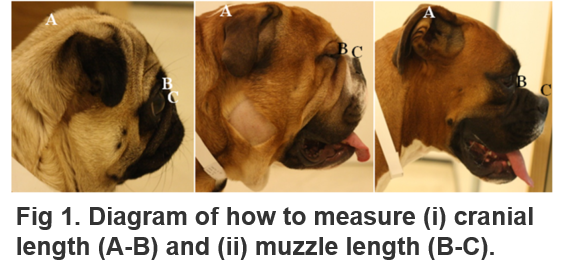
The study by Packer, et al. is timely and important. DogWellNet.com will be compiling and commenting further on this and similar research, in an effort to continue to assemble evidence pertinent to the Brachycephalic Issue.
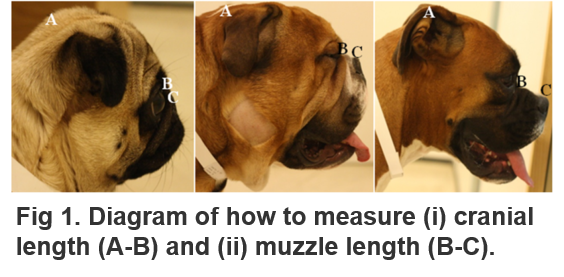
This image, from their study shows not only how they measured but also the extreme variation of muzzle length in 3 breeds.