






Brachycephalics
29 articles in this category
-
 UNDERSTANDING HUMAN ANIMAL INTERACTIONS Why do people buy dogs with potential welfare problems related to extreme conformation and inherited disease? This article features access to peer reviewed research published February 24, 2017 and more... The popularity of of breeds with heath issues is undeniable... why is this happening and how do we address the matter to improve the health and welfare in these breeds? See DWN downloads for Why do people buy dog
- We are in the process of compiling articles and materials that elaborate upon health management concerns for brachycephalic breeds. We will add to these resources over time, and encourage IPFD's Partners to assist us by providing relevant content. Please see the Breed Database pages for each of the Brachycephalic breeds - we welcome our content partners and breed experts to provide content for inclusion on the individual breed's pages. This collection of articles reflects work done to address the brachycephalic breed's issues by different countries, kennel clubs, the scientific research community, veterinarians and canine health and welfare experts. Breeder's efforts to produce healthy, typey dogs and judge's roles in awarding functional breed representatives play a significant part in individual dog's length and quality of life. Ultimately it is hoped that understanding and discussion of the issues will promote a promising future meeting the goal of improving health and welfare amongst the brachycephalic dog breeds.
The reference materials listed below are housed on the DogWellNet website in different categories - i.e., in Downloads, Forums, Blogs, the Breeds Database pages for brachycephalic breeds and in various DogWellNet Health and Welfare Categories.
-
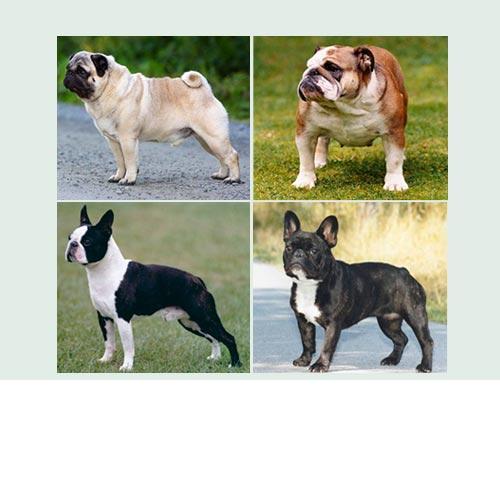 The International Partnership for Dogs (IPFD) and DogWellNet.com aim to support efforts to define and address issues of health and welfare in brachycephalic dogs by providing: a transparent and open environment, information sharing, and promotion of and support for international collaboration across stakeholder groups. We look to foster collaboration that starts from: the belief that all involved are committed to promoting health, well-being and good we
- In this section we will post links to ongoing efforts to address health and welfare in brachycephalic breeds by IPFD Partners and other stakeholders. We will include material to support international collaborations.
Click here to see an index - more brachy articles.
 Recently, veterinarians in Sweden sent an open letter to the Swedish Kennel Club (SKK) Swedish Board of Agriculture (link to original; English translation 'Open Letter ...' below). The letter proposes collaboration between the Swedish Kennel Club (SKK), veterinarians and regulators to address issues in brachycephalic breeds ('trubbnosar' in Swedish (snub-nosed)). While acknowledging the long time activities
- Developments in Sweden in the fall of 2015 serve to highlight the challenges of addressing health and welfare in 'flat-faced dogs', i.e. The Brachycephalic Issue. We follow them here, chronologically as they serve to exemplify the problems and, hopefully, to inform others working in this area.
 Brachycephalics: Research and Veterinary: External Resources Epidemiological associations between brachycephaly and upper respiratory tract disorders in dogs attending veterinary practices in England http://researchonline.rvc.ac.uk/9420/1/9420.pdf O'Neill et al. Canine Genetics and Epidemiology (2015) 2:10 DOI 10.1186/s40575-015-0023-8 Impact of Facial Conformation on Canine Health: Brachycephalic Obstructive Airway Syndrome http://journals.pl
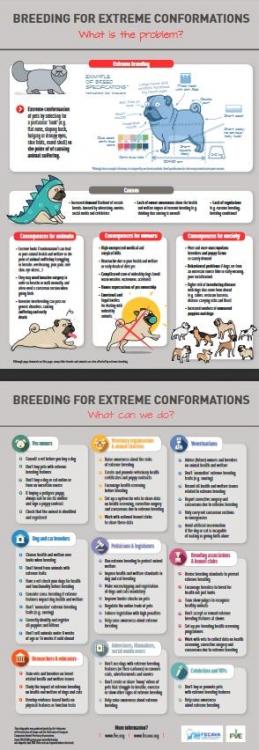 FECAVA: Healthy Breeding
- Brachycephalic issues: shared resources (multiple country's resources)
- Extreme Breeding Infographic BREEDING FOR EXTREME CONFORMATIONS - What is the problem? & What can we do? Causes, consequences...
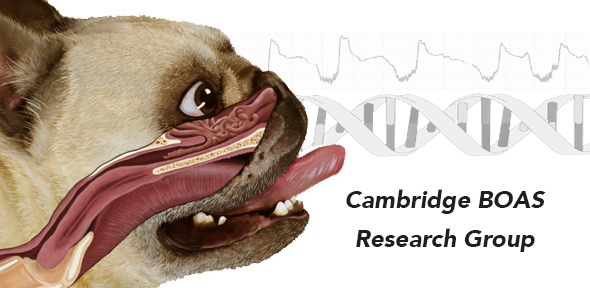 The Cambridge BOAS Research Group opened their new website in 2016. Great information on their programs and progress. Also background information on BOAS at a level for informed breeders, veterinarians and others. There are possibilities for dog owners and breeders in the UK to participate in and support this work.
Owners and breeders: See the flyer for an overview.
The Cambridge BOAS Research Group opened their new website in 2016. Great information on their programs and progress. Also background information on BOAS at a level for informed breeders, veterinarians and others. There are possibilities for dog owners and breeders in the UK to participate in and support this work.
Owners and breeders: See the flyer for an overview.
 Impact of Facial Conformation on Canine Health: Brachycephalic Obstructive Airway Syndrome (Rowena M. A. Packer, Anke Hendricks, Michael S. Tivers, Charlotte C. Burn; [PLOS] Published: October 28, 2015 DOI: 10.1371/journal.pone.0137496 ) Abstract The domestic dog may be the most morphologically diverse terrestrial mammalian species known to man; pedigree dogs are artificially selected for extreme aesthetics dictated by formal Breed Standards, and breed-related disorders linked to conformation
- Continuing our series on The Brachycephalic Issue: Today Rowena Packer and others have published the following study: Impact of Facial Conformation on Canine Health: Brachycephalic Obstructive Airway Syndrome (Rowena M. A. Packer, Anke Hendricks, Michael S. Tivers, Charlotte C. Burn; [PLOS] Published: October 28, 2015 DOI: 10.1371/journal.pone.0137496 ). The study concludes that shorter muzzles are associated with increased risk of health problems (Brachycephalic Airway Sydrome), even within affected breeds and offers a good discussion of practical implications and recommendations. As you will see at the end of the abstract (below), the authors suggest that "breeding organisations should actively discourage exaggeration of this high-risk conformation in breed standards and the show ring." Numerous articles on DogWellNet.com outline work that has been ongoing by some of our Partner organizations, e.g. the Breed Specific Instructions program (e.g., Swedish, Finnish and Norwegian Kennel Clubs); Finland Pug Study; work in Germany by the French Bulldog club and efforts by The Kennel Club in the UK, including Breed Watch. We are in the process of assembling a further catalog of efforts in this area. IPFD and DogWellNet.com will continue to compile and share resources on/for:
- evidence for the extent, prevalence and severity of issues of health and welfare,
- efforts - who is doing what, where to address issues, and
- evidence on what is working, challenges and barriers to moving forward.
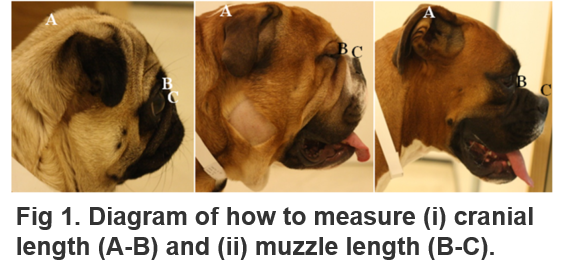
The study by Packer, et al. is timely and important. DogWellNet.com will be compiling and commenting further on this and similar research, in an effort to continue to assemble evidence pertinent to the Brachycephalic Issue.
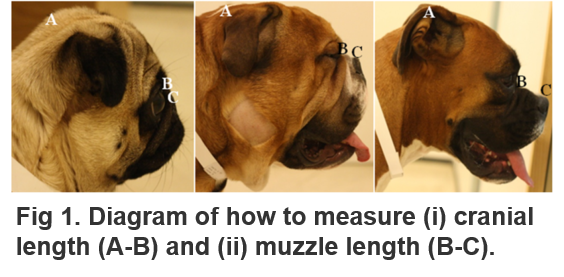
This image, from their study shows not only how they measured but also the extreme variation of muzzle length in 3 breeds.
 The Swedish Kennel Club and the Swedish Breed Club for English Bulldogs (SKEB - Svenska Klubben för Engelsk Bulldogg ) worked with researchers from 2007-2010 to study English Bulldogs. The purpose of the research was to advance understanding of clinical evaluation of tracheal hypoplasia. Tracheal hypoplasia is a congenital condition described in mainly brachycephalic breeds and one component of the brachycephalic obstructive airway syndrome (BOAS). See the Swedish research
- Research is ongoing.
Kennel clubs, researchers and breed fanciers in Sweden and France work to find ways to improve health in the English Bulldog breed.
 See the article which was published in the Veterinary Ireland Journal I Volume 5 Number 11 Dated link: http://www.veterinaryirelandjournal.com/images/sa_nov_2015 ... See Internal (Internal) Current thinking about brachycephalic syndrome-more than just airways
- "Brachycephalic syndrome (BS) describes the result of hereditary abnormalities occurring in dogs and cats from selective breeding for shorter heads and dorsorotation of the face. Although respiratory problems are the best recognised of the problems associated with BS, the problem is not limited to the respiratory tract, writes Kathryn M Pratschke, North East Veterinary Referrals, Northumberland Business Park West, UK"
 Results from BAER tests and walk tests are saved to the Breeding Database 7.9.2017 | Koiran terveys, Terveystarkastukset (link updated 7-9-2018) https://www.kennelliitto.fi/en/about-ut/news/results-baer-tests-and-walk-tests-are-saved-breeding-database About KoiraNet-jalostustietojärjestelmä - Kennelliitto Read more about the FKC database. For more information from the FKC on the Walk tests and Research on English Bulldogs see... The dog's exercise tole
- Results from two newly official health examinations are being added to the Finnish Kennel Club's Breeding Database. Results from BAER hearing tests and walk tests, the latter measuring the dog's exercise tolerance and breathing, are saved to the system starting from 6th August.
 Excerpt from the BBC's Science and Environment article... "Study Co-author Niels Pedersen, from the University of California, Davis, told BBC News: "We tried not to be judgemental in our paper. We just said there's a problem here, and if you are going to decide to do something about it, this is what you've got to work with. "If you want to re-build the breed, these are the building blocks you have, but they're very few. So if you're using the same old bricks, you're not going to be
- BBC's Science and Environment's latest article "English Bulldog health problems prompt cross-breeding call" by Paul Rincon brings to light a recent study, "A genetic assessment of the English bulldog". English Bulldog health problems prompt cross-breeding call - BBC News-internalarchive.pdf
 Another study, using a similar set of tests, has been done on Pugs, also in collaboration with the Faculty of Veterinary Medicine, University of Helsinki Veterinary Hospital and the Pug breed club. Twenty dogs were tested, 10 that were considered to be good and 10 that were considered bad in breathing. The test results suggest that those with elevated level of noisy breathing in the upper respiratory tract were also failing in the walking tests: they could not walk as fast and as long without di
- Updated information from the FKK:
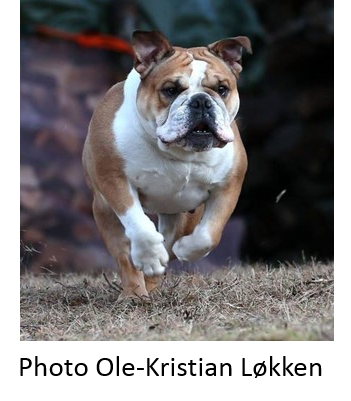 The Finnish Kennel Club (FKK) has today released information about a ongoing project 'Fitness examination being prepared for Bulldogs' [Dated link; see Internet Archive: https://web.archive.org/web/20151012050702/http://www.kennelliitto.fi/en/news/fitness-examination-being-prepared-for-bulldogs]in the English Bulldogs. This is a collaborative program between the kennel club, the breed club and The University of Helsinki Veterinary Hospital. Thirty English Bulldogs are being monitored for breathing, balance, a walking test, skin problems and x-ray'd from head to tail. The FKK has bought some equipment for the project and will pay for the study of the 30 dogs that the Breed Club has chosen to be tested. The aim is that this test could be used to evaluate dogs that would be suitable for breeding. Ultimately, the idea is to decrease health problems in any brachycephalic breed.
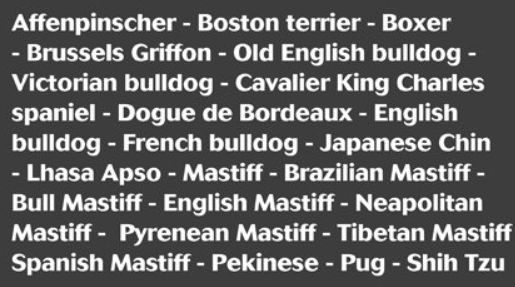 ♦ Nationwide Insurance - Brachycephalic Study -- March 2017 Read the March 2017 review at DVM 360... Data: Brachycephalic breeds suffer higher incidences of non-respiratory diseases Are brachycephalic breeds doomed for a lifetime of poor health? New data does not look promising for the pug and its fellow flat-nosed friends.
- The Nationwide® Brachycephalic Breed Disease Prevalence Study
Short-nosed breeds more often affected by common conditions, not just known issues "A biostatistical analysis of the pet health insurance claims of more than 1.27 million dogs over a nine-year span shows that even after removing conditions linked specifically to brachycephalic breeds, dogs with the structure common to these animals are less healthy than dogs with a more normal canine appearance."
 Brachycephalic breeds - A few highlights from 2017 January 2017 - Vet Journal Research: Comparison of submaximal exercise test results and severity of brachycephalic obstructive airway syndrome in English bulldogs http://www.sciencedirect.com/science/article/pii/S1090023316302106 February 24, 2017 Health and Welfare: A research paper was published that explores the matter of people's motivations in purchasing breeds of dogs. Why do people buy dogs with potential welfare
- Addressing health issues in brachycephalic breeds remains an ongoing topic of interest across the veterinary, research and breed communities as well as impacts animal welfare laws and regulatory agencies in governments. Although there is growing awareness of the potential welfare issues involved, there is clearly still a requirement for education of veterinary professionals, dog breeders and the wider public. This article provides information on a few developments in 2017.
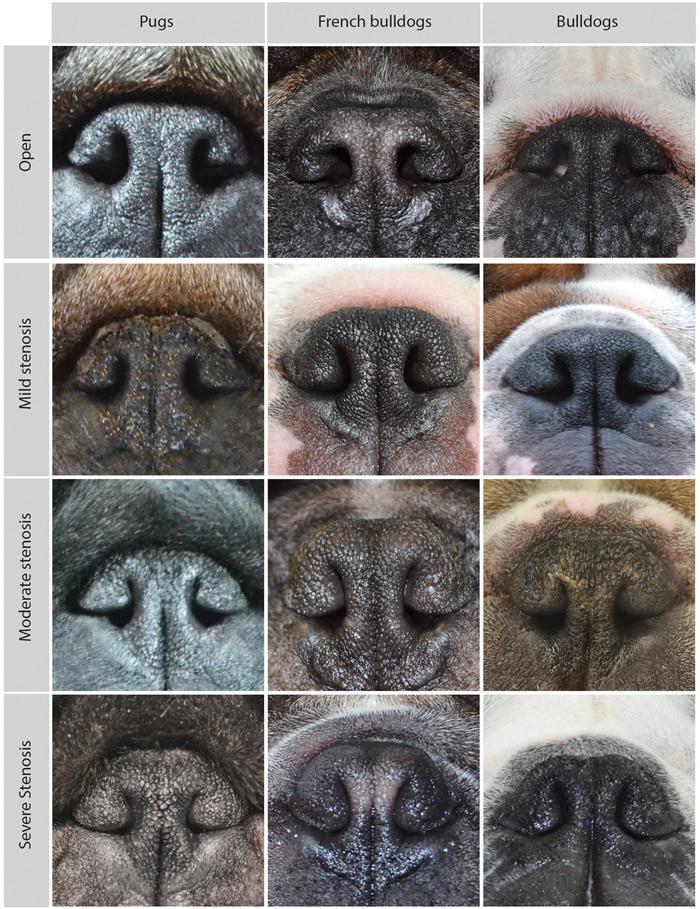
 In this study, although essentially all Pugs had observable breathing sounds, the loudness of the sounds and how well dogs did on a walking test seemed to separate the good and bad breathers quite well. The conformation of the nares was not predictive of owner-reported breathing status. As part of helping IPFD and DogWellNet.com in assembling information on The Brachycephalic Issue, the FKK has shared the attached document (below). We hope to have further information soon, includi
 The attached paper describes a preliminary study done at the Faculty of Veterinary Medicine of The University of Helsinki at the request of and in collaboration with The Finnish Pug Club. The study aimed to determine whether aspects of clinical history and symptoms or other evaluations could differentiate between dogs identified by their owners as 'good' or 'bad' breathers. It is a small study - 20 Pugs in total - but the findings are interesting and have been used by the Finnish Pug Club and the Finnish Kennel Club (FKK) to inform work on health issues in this breed.
 Abstract Brachycephalic obstructive airway syndrome (BOAS) is an important health and welfare problem in several popular dog breeds. Whole-body barometric plethysmography (WBBP) is a non-invasive method that allows safe and repeated quantitative measurements of respiratory cycles on unsedated dogs. Here respiratory flow traces in French bulldogs from the pet population were characterised using WBBP, and a computational application was developed to recognise affected animals. Eighty-nine Fre
- The first formal paper from the Cambridge study mentioned in another article in The Brachycephalic Issue was published in June: Characterisation of Brachycephalic Obstructive Airway Syndrome in French Bulldogs Using Whole-Body Barometric Plethysmography. See the Abstract (below). This work offers exciting new possibilities to advance health and welfare in brachycephalic breeds.
 Update on actions in Sweden and the Nordic Kennel Union - May - June 2016 Norway Health and welfare in brachycephalic dogs---NKK 15 June 2016.pdf The Norwegian Kennel Club - Focus on brachycephalic breeds NKK - Focus on brachycephalic breeds 11-04-2016.pdf "The Norwegian Kennel Club has for a significant time focused on the problems regarding respiratory issues and problems with temperature regulation for the brachycephalic
- "Following the Swedish Kennel Club (SKK) Symposium on Brachycephalic Dogs in February 2016, the SKK issued a press release describing the background, current and future actions related to brachycephalics. See article and press release on DogWellNet.com. Included in that report was a statement on the breeding of brachycephalic dogs and strategies to improve the health status. It was indicated that actions must be taken with cooperation across many stakeholder groups."
 Here we provide links to information posted by the Norwegian Kennel Club and The Finnish Pug Club on approaches to and initiatives for management of health and welfare in brachycephalic breeds.
The Swedish, Finnish and Norwegian Kennel Clubs are part of The Nordic Kennel Union.
Here we provide links to information posted by the Norwegian Kennel Club and The Finnish Pug Club on approaches to and initiatives for management of health and welfare in brachycephalic breeds.
The Swedish, Finnish and Norwegian Kennel Clubs are part of The Nordic Kennel Union.
 Summary of work and resources... 2015-2016 The Kennel Club in the UK has recently hosted a meeting on the brachycephalic breeds and will provide further information on the results of that meeting. The meeting was prompted by a petition on the topic by UK veterinarians. Early reports indicate that various stakeholder groups are stepping forward to examine what they can do. Dated Link One view on the meeting has been presented by Dog World: Vets’ petition prompts KC to
- It is great to see the increased momentum for addressing issues of health and welfare in brachycephalics around the world. IPFD hopes to facilitate collaborative international efforts across multiple stakeholder groups. It is clear that this issue is a global one and requires a coordinated approach to be truly effective. Perhaps what is also needed is a recognition that these are complex challenges, with no easy solution. The issues involve not only medicine and science, but are fraught with emotion and influenced by long-held beliefs. Aspects of human-dog interactions both enrich and complicate the situation. Success is most likely to come from positive collaborative efforts where all stakeholders take responsibility for their own roles and work together on common goals, rather than trying to criticize others and apportion blame. There is a need for information and evidence, compiled and interpreted in a logical and unbiased way. There is a need to share resources, experience and expertise, with reduction of redundant efforts. There is need for courage, as this is a challenging and evocative issue. But there is also a need for compassion - for the dogs, first of all, but also for owners who may not understand; for breeders who did not set out to purposely create problems; to veterinarians who may struggle with conflict of interest serving their business, their clients and their patients; for dog show judges, many of whom struggle for a balanced approach; and more. The controversies and challenges represent an opportunity now to work together to enhance the health, well-being and welfare of dogs and to support human-dog interactions. See below for a summary of and links to recent international efforts and resources. We will continue to edit and update this document.
 In the Press - SKK - Brachycephalic (Swedish) Så ska hälsoläget för kortskalliga hundar förbättras Pressmeddelande • Maj 10, 2016 13:17 CEST Dated link: http://www.mynewsdesk.com/se/svenska_kennelklubben/pressreleases/saa-ska-haelsolaeget-foer-kortskalliga-hundarfoerbaettras-1400034 News Item: SKK -- Statement and strategies (Uttalande och strategier efter brakycefalkonferensen) -- Dated link: http://www.skk.se/?newsitem=27323 (English translat
- Earlier this year SKK arranged a conference on the short-headed dogs. The content of the conference has now been reviewed by a working group and resulted in a statement and strategies for future work on the issue. May of 2016 -- the SKK has posted several news releases pertaining to outlining management strategies for 'snub-nosed' breeds as follow-ups to the February conference.
VIDEOS of the conference presentations are available on SKK's YouTube:
 Carol Beuchat, PhD, from The Institute of Canine Biology, has written an excellent and comprehensive coverage of how the conformation of the brachycephalic affects physiological processes and health. In her article Brachycephaly: it's more than just the pretty face she provides a detailed, comprehensive and technical description of the impact of a shortened skull in dogs. One example of a simple lay description of the issues in brachycephalics is found under DOGS WITH SPECIAL FACES. This
Many of the articles in this section of DogWellNet.com on The Brachycephalic Issue focus on challenges and efforts at breed club, kennel club, national and international levels and across diverse stakeholder groups - breeders, breeding advisors, veterinarians, researchers, regulators and others. Many visitors to this site will be well-acquainted with the physical, physiological and welfare issues in individual dogs and for breed populations. In this article, we point to some resources that are available describing the problems that can arise because of the brachycephalic conformation. There are many articles online - below we highlight a few that have useful information and a variety of approaches.
 See... The SKK Brachycephalic Conference Agria Breed Stats Presentation Brachy conference Brenda Bonnett, DVM, PhD See Brenda's presentation BONNETT_Agria Breed Stats Brachy Conference Feb 2016.pdf "Dr. Brenda Bonnett has for a long period of time worked on Agria Breed Profiles, a compilation of insurance data based on dog breeds. Breed Profiles have been developed in conjunction with the SKK and was requested by several breed clubs. The summaries
- This is a translation of an article by Åsa Linholm which will appear in the Swedish Kennel Club magazine: Hundsport Special nr 2:2016. Introduction:
The hottest topic in the Swedish dog world in summer of 2015 has been brachycephalic (flat-faced) dogs and their health.
In February 2016 the Swedish Kennel Club arranged a conference on the subject, an arrangement that was right in time,
but in fact was planned since 2014.
 From 2016... The Swedish Kennel Club's Brakycefali - konferens om kortskalliga hundar More video presentations (some in English) are available in the Playlist Cambridge - BOAS Research - https://www.youtube.com/channel/UCR-Qc79RMonT58mujFrCx9A/featured "In recent decades, breeding selection for extreme brachycephalic features has resulted in dogs that are predisposed to upper airway tract obstruction and subsequent respiratory distress, among several other health is
- Here you will find a selected group of videos that address brachycephalic issues.
 excerpt from the Introduction... "BOAS is a serious welfare issue [7, 8]. The average lifespan of brachycephalic breeds is reduced by approximately three years when compared to that of mesaticephalic and dolichocephalic breeds of similar body size [9±12], with much of this difference likely due to BOAS and its syndromic effects. The problems caused by BOAS have been compounded by the increased popularity of the three extreme brachycephalic breeds named above over the last two decades in the
- Authors: Nai-Chieh Liu 1, Eileen L. Troconis 1, Lajos Kalmar 1, David J. Price 1, Hattie E. Wright 1, Vicki J. Adams 2, David R. Sargan 1, Jane F. Ladlow 1 *1
Department of Veterinary Medicine, University of Cambridge, Cambridge, Cambridgeshire, United Kingdom, 2 Vet Epi, Mildenhall, Suffolk, United Kingdom Read the paper at: http://journals.plos.org/plosone/article?id=10.1371/journal.pone.0181928 PDF: http://journals.plos.org/plosone/article/file?id=10.1371/journal.pone.0181928&type=printable
 Article: 2017 - Kennel Club Launches Learning Resource for Health Concerns in Brachycephalic Breeds Updated 5-28-2021: To Get Access to the Academy Resources: Create an account info is available on the KC's FAQ page. It's worth signing up! Brachycephalic obstructive airway syndrome - learn how it affects brachycephalic breeds (short-nosed dogs e.g. Pugs, Bulldogs and French Bulldogs) and the signs and symptoms that owners/potential owners should be aware of. An Overview: ht
- "The Kennel Club has launched a Brachycephalic Obstructive Airway Syndrome (BOAS) online learning resource on the Kennel Club Academy, to provide free and easily accessible education to those with an interest in BOAS and the research being undertaken at Cambridge University with brachycephalic dog breeds."
 Reporting of surgeries and deaths in brachycephalic dogs In April 2018, the Swedish kennel club introduced the possibility to report surgery in the respiratory tract of brachycephalic dogs with clinical problems. A possibility to report surgery on brachycephalic dogs have been requested for a long time from veterinarians and the Swedish kennel clubs´ (SKK) breed clubs. In a veterinary petition 2015*, a letter signed by hundreds of Swedish veterinarians, was sent to SKK and the Swedish
- SWEDEN Collaboration and problem solving -- brachycephalic breeds... thanks goes to the SKK for their continued work to address health and welfare issues in dog breeds. Here you will find information pertaining to management of brachycephalic dog breeds - discussion and actions - by representatives from Swedish Veterinary Association, the Swedish Board of Agriculture, the County Administrative Board, the Swedish University of Agricultural Sciences and SKK. Many thanks go to SKK's Linda Andersson for sharing this write-up with the DogWellNet community.

 As they note, and as has been noted by many, diagnosis of the BOAS syndrome and measurement of its severity can be challenging. In Rowena Packer's study, introduced in another article in this series, the researchers used a combination of clinical history, owner questionnaires, examination for stenotic nares and a new standardised clinical examination protocol to identify dogs affected by BOAS. The authors discuss that there could have been some mis-classified dogs because they were unable to u
- Continuing our series on The Brachycephalic Issue: An exciting research project is underway at Queen’s Veterinary School Hospital, Department of Veterinary Medicine, University of Cambridge spearheaded by a stellar team of researchers : Jane Ladlow, MA VetMB CertSAS CertVR DipECVS MRCVS; Dr David Sargan, MA PhD; Dr Vicki Adams, DVM MSc PhD MRCVS; and Nai-Chieh Liu DVM MPhil into the Brachycephalic Obstructive Airway Syndrome (BOAS). In their flyer, Non-invasive Respiratory Function Assessment in Brachycephalic Dogs, they describe the study and call for participants in the UK. (internal link flyer -- BOAS flyers version 4 .pdf) This group has also published their findings in French Bulldogs. See: The Brachycephalic Issue: Evidence and Efforts: Characterisation of Brachycephalic Obstructive Airway Syndrome in French Bulldogs Using Whole-Body Barometric Plethysmography
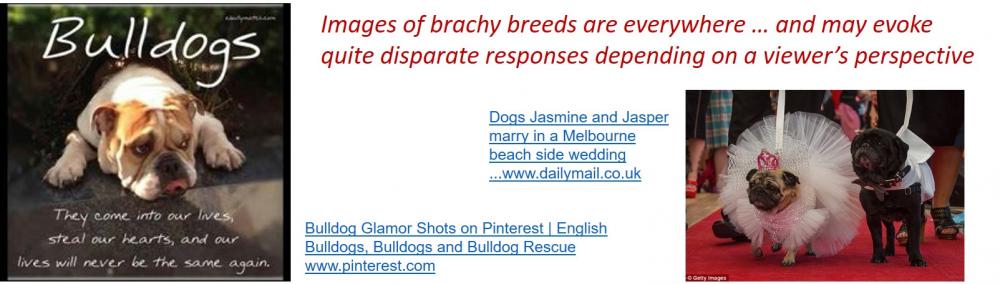
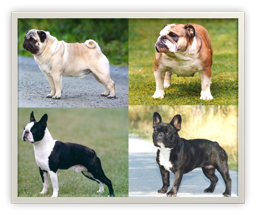
 French and English bulldogs, Cavalier King Charles Spaniels and pugs... The 2018 Evolution of Petface article references the American pet insurer Nationwide's 2017 Study Report, provides links to the Cambridge Veterinary School's BOAS disease recognition by owners & veterinarians and to the 2017 Danish study which highlights a paradox, "Why do people buy dogs with potential welfare problems related to extreme conformation and inherited disease? A representative study of Danish o
 The Evolution of Petface
 The same traits that make these dogs adorable threaten their health and well-being
By Kat Eschner
The same traits that make these dogs adorable threaten their health and well-being
By Kat Eschner
smithsonian.com
January 31, 2018 8:30AM






Important Information
By using this site, you agree to our Terms of Use.