






DNA tests - DM - AKC-CHF Webinar

· Viewed: 2,136 times
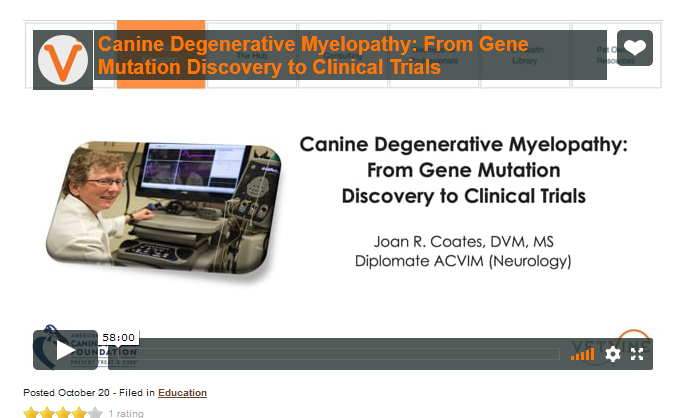 Following discussions at the August 2019 AKC Canine Health Foundation National Parent Club Canine Health Conference, DogWellNet.com's collaborators at AKC-CHF hosted a webinar available for viewing at VetVine, Canine Degenerative Myelopathy: From Gene Mutation Discovery to Clinical Trials (free VetVine registration required).
Dr. Joan Coates' presentation (free VetVine registration required) gave a detailed overview of the disease and current research, including veterinary and human applications. In this excellent overview, parts of the presentation were somewhat technical – digestible to a veterinarian or researcher level audience – but nonetheless also of interest to breeders. The application side of this test, i.e. what results mean and how the test should be used to support breeding decisions, is particularly complex, and the situation is very different in various breeds. This complicates the situation for owners and breeders in terms of deciding whether this highly-marketed test is needed, and in interpretation of the results.
Dr. Coates mentioned that, in the paper by Jonas Donner and colleagues: Frequency and distribution of 152 genetic disease variants in over 100,000 mixed breed and purebred dogs, Degenerative Myelopathy is the most common 'disease'. [See statistics: Rank 1: Allelle frequency]. BUT, it is really the most commonly tested for disease – for various reasons. We do not have great evidence on the actual prevalence of the condition across or within breeds.
Challenges - Confusion over interpretation and application of DNA tests within the breed and veterinary communities is not unique to DM. Working groups coming out of the genetic theme at the 4th IDHW are underway to address validation issues in genetic testing.
Stay tuned to DogWellNet.com, as we will be providing more information in the near future.
The DNA testing topic is being addressed by IPFD's partners, collaborators and team through development and implementation of tools such as the HGTD as well as covered in Themes work done at the IPFD's International Dog Health Workshops, the IPFD CEO's outreach presentations, articles and blogs* - work done in collaboration with individuals and groups of multidisciplinary stakeholders, all of whom share the aim to improve the health and welfare of dogs.
Additional information... Talks & Blogs - Genetic Testing
Recently, Brenda Bonnett blogged about challenges faced by breed clubs related to applying results of this particular DNA test (DM) to breed management in Concern about genetic testing Degenerative Myelopathy (DM) in French Bulldogs. The blog includes a link to a letter, Degenerative Myelopathy Does NOT Occur in French Bulldogs that IPFD collaborator Dr. Jerold Bell circulated to add to the discussion/understanding of DM testing in the French Bulldog breed.
The current state of affairs for canine genetic testing development and distribution, along with comments on appropriate interpretation and application of DNA tests to improve health of dogs, are discussed In Brenda Bonnett's talk to AVMA in August 2019: Genetic Testing to Improve Canine Health: The Big Picture & the Blog covering the AVMA conference.
A presentation Harmonization of Genetic Testing and Breed-Specific Resources was given at the AKC-CHF Parent Club Health Symposium. Brenda’s Blog offers further discussion.
RELATED: Video: Canine Degenerative Myelopathy - Stages of Disease
"Veterinary neurology expert Dr. Joan Coates, DVM, MS, DACVIM (Neurology) discusses the progressive nature of canine degenerative myelopathy and provides examples of affected dogs in the various stages of progression. Learn more on this topic and view the entire presentation On Demand.
Recommended Comments